Based on Group's presence in Poland (through KTI Poland), Fondazione MAIRE presents its “Climate Goals” research on energy transition in the frame of the XIII Polish Chemistry Congress in Warsaw
PRESS RELEASEFOCUS ON THE POLISH SYSTEM, WHERE CLIMATE GOALS TARGET MUST BE BALANCED WITH SOCIO-ECONOMIC STABILITY, WHILE ENSURING INDUSTRIAL COMPETITIVENESS AND SKILLS DEVELOPMENT
- Fondazione MAIRE, together with Ipsos Doxa, has been monitoring public awareness on the energy transition worldwide since 2023, involving more than 2,850 individuals and 25 experts across 17 countries in 4 continents
- Poland is a strategic country for MAIRE, in the frame of its European platform of technology and engineering which is based on Group's rooted presence in 6 countries of the continent (Italy, The Netherlands, Germany, Switzerland, UK and Poland)
- Polish respondents call for greater innovation from business, stronger institutional support for new technologies, and a transition that is evidence-based, well-managed and supported by skills development
- Training is the key enabler: 87% require strong upskilling improvement, with hybrid professionals combining technical expertise with soft skills such as critical thinking
Warsaw, 12 June 2026 – Fondazione MAIRE – ETS presents the results of the fourth edition of “Climate Goals: winning the challenge of climate goals through the creation of skills and competences worldwide” (Addendum 3), with a dedicated focus on Poland, one of the European countries where the energy transition is assessed primarily in relation to energy security, economic sustainability and industrial competitiveness. The research has been presented during the works of the XIII Polish Chemistry Congress in Warsaw, the largest and most prestigious annual gathering for the chemical sector in Poland and Central Europe, bringing together representatives of public administration, industry leaders, the scientific community and companies active across the value chain.
The presentation was delivered by Ilaria Catastini, General Director of Fondazione MAIRE – ETS – at the presence of the President of the Polish Chamber of Chemical Industry Dr. Tomasz Zielinski, and the First secretary and Head of economic affairs of the Italian Embassy in Poland Dr. German Carboni – ahead of the discussion panel “Energy transition in industry: from technologies to implementation”, which brought the debate into a broader industrial perspective with the participation of leading sector players including Marcin Wasilewski, Member of the Management Board for Transformation at ORLEN, Piotr Miecznikowski, President of the Management Board, Honeywell, Artur Pierscionek, Director of Heat Sales and Energy Transformation, Veolia, and Emanuele Pozzati, Polymers Engineering & Adwin Solutions Vice President of Nextchem (MAIRE Group).
Promoted by Fondazione MAIRE – ETS and carried out with Ipsos Doxa, with the support of MAIRE, the research has been tracking public awareness of the energy transition worldwide since 2023, looking beyond low- or zero-emission energy production to include the transformation of industrial processes, products, business models, distribution systems, and the skills required to enable this shift.
The 2026 edition expanded the European scope of the survey by including Germany, Poland and the Netherlands, bringing the total number of countries covered to 17[1]. In Poland, the findings portray a country where the energy transition is not rejected, but rather examined through a highly rational lens, in which climate goals must be balanced with socio-economic stability, the cost of decarbonization and the need to protect strategic industrial sectors.
In Poland, awareness of the energy transition remains superficial: 58% of the respondents say they have only a vague understanding, while just 39% consider themselves very familiar with it. This helps explain why the energy transition ranks as the lowest priority among the European countries, and also among all the 17 Countries of the research panel, with only 20% of respondents identifying it as a top priority and 66% placing it on the same level as other key issues. The findings point to a cautious and pragmatic national approach, shaped by concerns over socio-economic stability, industrial competitiveness and energy security.
This perspective is reflected in the strong attention paid to economic and social trade-offs. While 25% of respondents are concerned about job losses in traditional sectors, 31% also recognise the potential for job creation in sustainable industries. Responsibility for the transition is seen as shared almost equally among private companies, politicians and citizens, while expectations remain concrete: respondents call for greater innovation from business, stronger institutional support for new technologies, and a transition that is evidence-based, well-managed and supported by skills development. In this context, training emerges as a key enabler: only 4% feel the Country is fully prepared for the transition, 87% say it needs to improve training, and 79% highlight the importance of hybrid professionals combining technical expertise with soft skills such as critical thinking.
MAIRE is a leading engineering group providing technology solutions and project execution in the downstream segment of energy services, as well as in the chemical and fertilizers industries, with 10.800 employees in 50 countries. In Poland, the Group benefits from a strong and well-rooted industrial presence through KTI Poland S.A., an international EPC company established in 2006 from Technip heritage. With solid expertise in the design and implementation of plants for the oil & gas, petrochemical, chemical and energy industries, KTI Poland delivers services across the full project lifecycle, from feasibility studies and Front-End Engineering Design (FEED) to detailed engineering and construction management. Based in Płock – one of the country’s key industrial hubs – and with offices in Warsaw, the company brings together multidisciplinary engineering expertise and execution capabilities to support the efficient delivery of complex industrial initiatives.
Fabrizio Di Amato, Chairman of MAIRE and Fondazione MAIRE – ETS, remarked: “The Polish outlook confirms that the energy transition must move forward with pragmatism, responsibility and a clear industrial vision. With our consolidated presence in Poland, which we regard as a strategic platform for further growth in Central and Eastern Europe, MAIRE sees this market as a key hub for advancing innovative industrial solutions. In other words, Poland is a key pillar in our European strategy, which is based on Group's rooted presence in 6 countries of our continent such as Italy, the Netherlands, Germany, Switzerland, UK and Poland. Today, energy transition is a key to reach energy security, and create industrial competitiveness, by converting sectors linked to the traditional economy to new low carbon processes and products, and introducing circularity into the economy. This requires execution capabilities, investment in innovation and the development of the right skills to support a transition that is an opportunity, where benefits may overcome costs”.
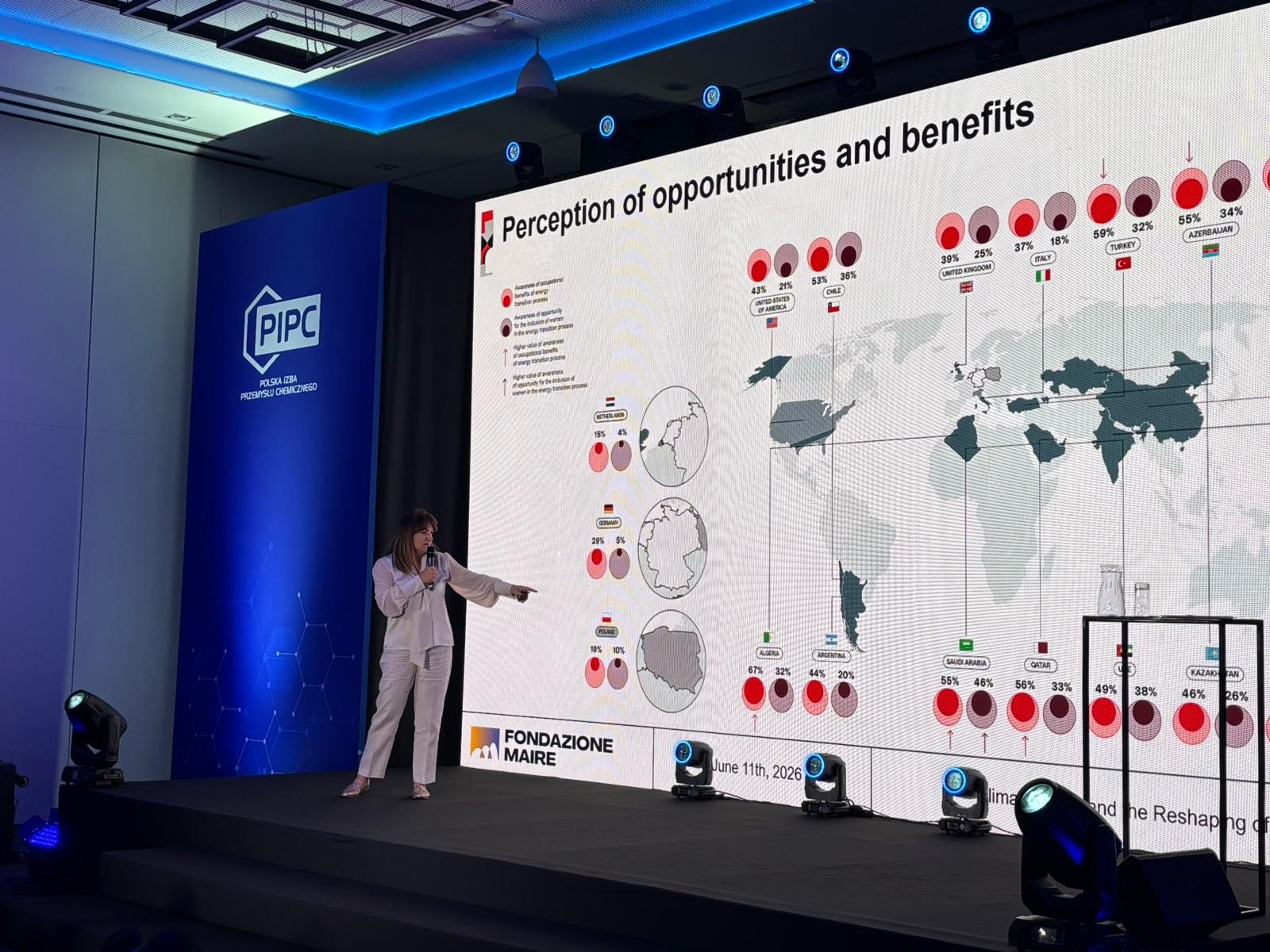
[1] The research draws insights from 2,850 individuals and integrates the views of 25 experts in 17 countries across 4 continents: Qatar, Saudia Arabia and the UAE for the Middle East; India, China, Azerbaijan, Kazakhstan and Turkey for Asia; USA, Chile and Argentina for the Americas; Algeria in Africa; Germany, Italy, Poland, The Netherlands and UK for Europe.