TECHNOLOGY, ENGINEERING, AND EXECUTION. CAPITAL MARKETS DAY REVEALS THE IDENTITY OF A GLOBAL PLATFORM WHERE ENERGY SECURITY, GEOPOLITICS, AND INDUSTRIAL POLICY PLAY A DECISIVE ROLE.
There is a moment during Capital Markets Day when the narrative shifts. The slides fade into the background, but what emerges is something more concrete: a sequence of examples, technologies, and projects that transform the vision into observable reality. It is in this transition that MAIRE's CMD – held in early March 2026 – took on its truest meaning. In addition to being a meeting with the financial community, it was an opportunity to highlight how the Group is translating the energy transition into scalable industrial solutions.
From technologies for circular chemistry to new energy carriers, and integrated models blending innovation and execution, the narrative unfolded through projects that are either already active or in an advanced stage of development. On the one hand, the ability to interpret an energy landscape that is increasingly complex and rapidly evolving; on the other, the determination to translate it into operational opportunities, with an approach that combines strategic vision and solid execution. In essence, the demonstration of an industrial model in action, bringing together technology, engineering, and implementation capabilities to address the challenges of the transition.
A platform driving change
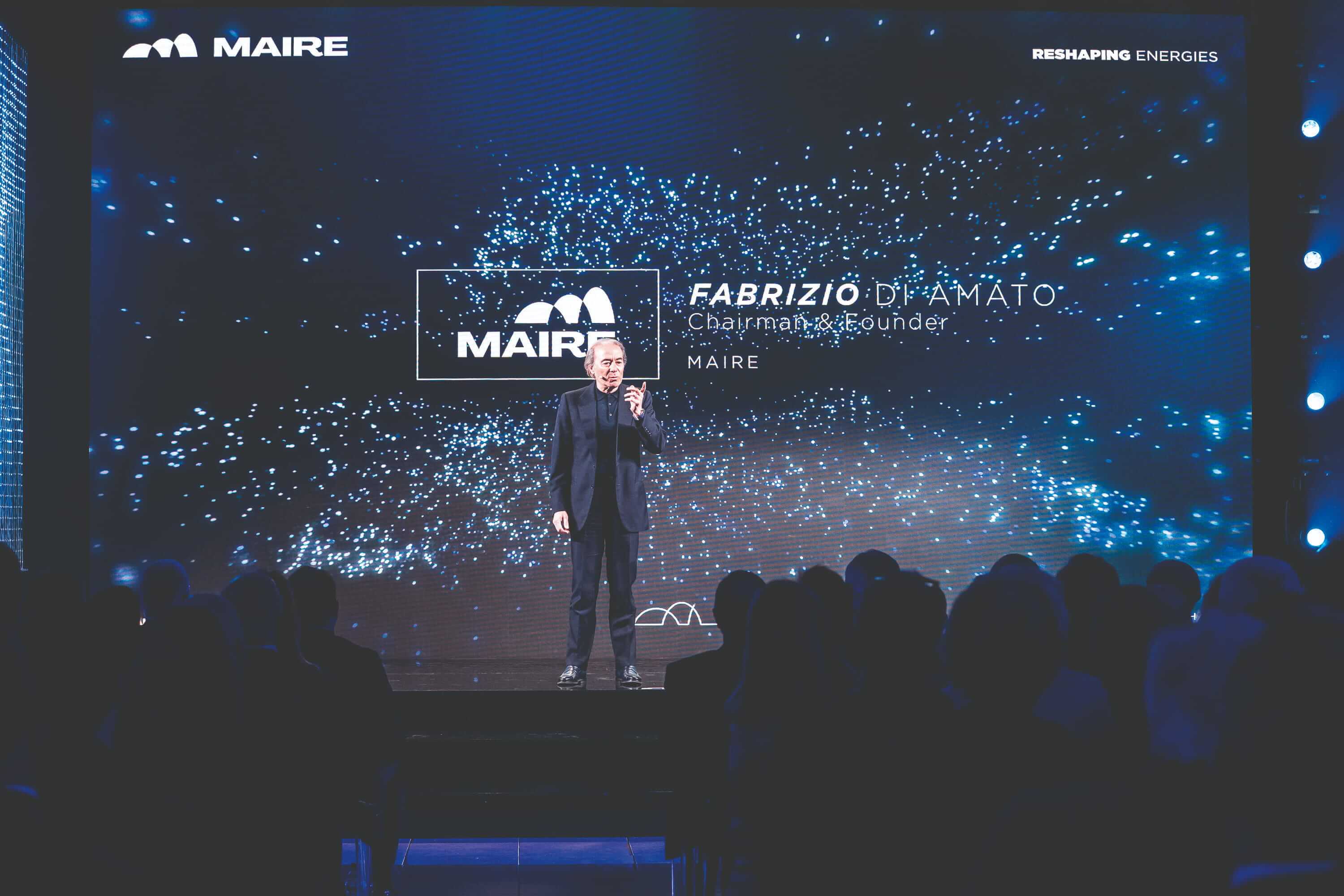
Opening Capital Markets Day was Fabrizio Di Amato, Chairman and Founder of MAIRE, with a discussion on the role of industry during a period of profound transformation. « Today, the world needs industry more than ever, – explained the Chairman. – We need energy, new materials and processes, and innovation to combine economic development with environmental responsibility. »
The energy transition, therefore, is a process already underway, influenced by geopolitical dynamics, technological advancements, and new geographical patterns of demand. Despite the opportunities, the context requires a combination of vision and discipline in execution. « What seems ambitious today becomes reality tomorrow », added Di Amato, presenting MAIRE's journey as a coherent evolution: from a company built over time through the integration of expertise and acquisitions, to a global platform capable of combining technology and implementation capabilities.
The integration of NEXTCHEM and TECNIMONT
With TECNIMONT, the focus shifts to execution. This is where the Group's industrial vision takes operational form, through the management of complex projects on a global scale. In 2025, the Integrated E&C Solutions division recorded revenues of €6.6 billion and growing EBITDA, confirming the strength of the model based on engineering capabilities and executional discipline. This result was supported by progress on major projects in the portfolio and selective management of new contracts.
CEO Alessandro Bernini frames these results from a broader perspective: « Over the past three years, we have doubled revenues and recorded steady growth in profitability at all levels. ». In 2025, the Group's revenues reached €7.1 billion, with EBITDA of €500 million and a margin rising to 7%, an improvement over 2022. « Even more importantly, we tripled consolidated net profit, reaching €285 million, the best result ever. » It is within this framework that « the strength and resilience of our industrial model, even in an increasingly complex energy and geopolitical context », comes into play. The approach is integrated: from preliminary studies through to the construction and operation of plants. In this context, the growing adoption of digital solutions and artificial intelligence is helping to improve operational efficiency and the quality of execution.
« We are positioned to grow by leveraging two complementary drivers: NEXTCHEM and TECNIMONT. » It is through this integration that MAIRE's industrial model reaches its peak. On one hand, technological development; on the other, execution capability: two distinct yet increasingly interconnected drivers that enable us to support projects throughout their entire lifecycle, from innovation to implementation.
Energy sources destined to coexist
Following the presentation of the vision, Capital Markets Day got into full swing with a talk by Giovanni Sale, SVP Corporate and Business Strategy, who was asked to outline the context in which this vision takes shape. « Global population growth, GDP expansion, and rising living standards are driving a structural increase in energy demand, with emerging economies playing an increasingly significant role », explained Sale.
A further accelerating factor adds to this dynamic. « A new force is at work: the exponential rise in energy demand driven by electrification and artificial intelligence. » As its overall capacity increases – through new infrastructure, new materials, and new industrial solutions – the global energy system brings with it a high degree of complexity. « The new energy paradigm is based on two pillars: a multi-source system and a multi-shape, multi-speed scenario. » In other words, different energy sources are destined to coexist, while countries and sectors follow distinct trajectories, influenced by economic, political, and industrial priorities.
Alongside energy, Sale highlighted a second key element: the role of materials and their processing. The growth of the energy system implies, in fact, a rising demand for resources – from metals to strategic raw materials – and, above all, the ability to process them efficiently. In this context, chemistry once again becomes an enabling factor, necessary to support the development of infrastructure, storage systems, and mobility.
The picture that emerges is that of an expanding system, yet one that is also increasingly fragmented and competitive, where energy security, geopolitics, and industrial policies play a decisive role. In this scenario, MAIRE's positioning is clearly defined: « A global technology and engineering partner, continuously evolving and expanding ahead of the market. » A role that requires the ability to operate in diverse contexts, manage complexity, and offer scalable and pragmatic solutions.
From feedstock to final product
Fabio Fritelli, Managing Director of NEXTCHEM, described 2025 as a pivotal year: « It was a crucial period for our sector, a year that redefined the meaning of the energy transition », Fritelli said. In this context, NEXTCHEMhas strengthened its position as an integrated technology platform. The model is not limited to developing solutions but aims at their industrialization, combining licensing, engineering, digital services, and proprietary components. « It is an approach that allows us to support customers along the entire value chain, from feedstock to the final product. »
The numbers confirm this trajectory. In 2025, revenues reached €495 million, with significant growth and margins among the highest in the industry. At the same time, the technology portfolio continued to expand, exceeding 50 available solutions and set to grow further with the integration of new acquisitions. « In 2025, we also announced the acquisition of Ballestra Group – added Fritelli – a strategic transaction that expands our portfolio in inorganic chemistry, strengthens our research and development capabilities, and consolidates NEXTCHEM's positioning in segments related to critical materials and fertilizers. »
The development strategies are structured around three areas: fertilizers, new energy carriers – such as SAF, methanol, and hydrogen – and solutions for material circularity. Growth also involves targeted acquisitions. « We are extremely selective, – concluded Fritelli, – we seek only technologies with a proven level of maturity. » The goal is to accelerate time-to-market and transform already tested solutions into industrial applications on a large scale.
GERMANY, THE MAIRE LABORATORY